
Shelby County Arrest Records Path
Shelby County arrest records document the arrest and custody event. The Sheriff's inmate listing may show an inmate number, name, booking date, charge description, bond type, bond amount, and total bond. Those visible descriptions are booking or custody charges. They may not be the complete accusation later filed in court, and they do not establish the final result. A person can be booked on more than one charge, held on an alias writ, released on bond, or transferred while the legal case continues.
Court charges after arrest follow a different record path. A prosecutor reviews the matter, and the filed accusation becomes part of a District, Circuit, or Municipal Court case. In Shelby County, Matt Casey serves as District Attorney for the Eighteenth Judicial Circuit. Circuit Clerk Mary H. Harris keeps the county's state trial-court files. The complete Shelby County criminal case file then tracks pleas, motions, hearings, disposition, and sentence, while the arrest record stays with the law-enforcement or jail custodian.
Find Shelby County Arrest Records
Use the Shelby County inmate listing for current custody, recent arrivals, releases within the last thirty days, and visible booking charges. Search by last name or browse the letter filters. Then use the Alacourt Shelby County docket for court settings by date and optional last name. Alacourt Access may provide broader state trial-court data through an account. These official channels answer different questions, so check the booking entry and court record separately.
- Search the Sheriff's listing by last name for the arrest or booking-side entry.
- Record the displayed name, booking date, charge description, and bond data.
- Check Alacourt for a related District or Circuit Court docket and case number.
- Compare every filed charge with its current status and eventual disposition.
- Ask the Circuit Clerk for a certified charge disposition when proof is required.
If neither county system fits, identify the custodian. Municipal misdemeanors inside city limits go through that city court or police department. A sentenced person transferred to state prison is searched through ADOC, not the county jail list. Jail Division questions can go to 205-670-6066. For court copies, submit the Circuit Clerk's search and copy form by mail or in person. It accepts a known case number or approximate filing year, identifying information, and a request for certification.
The official Shelby County Sheriff AL mobile app is another custody-side channel. Its Apple listing and Google Play listing advertise inmate listings, alerts, crime tips, road closures, and public-safety news. The app is not an emergency line, and its listings do not replace a certified charge disposition.
The Shelby County Sheriff bonding page explains release methods tied to a booking.
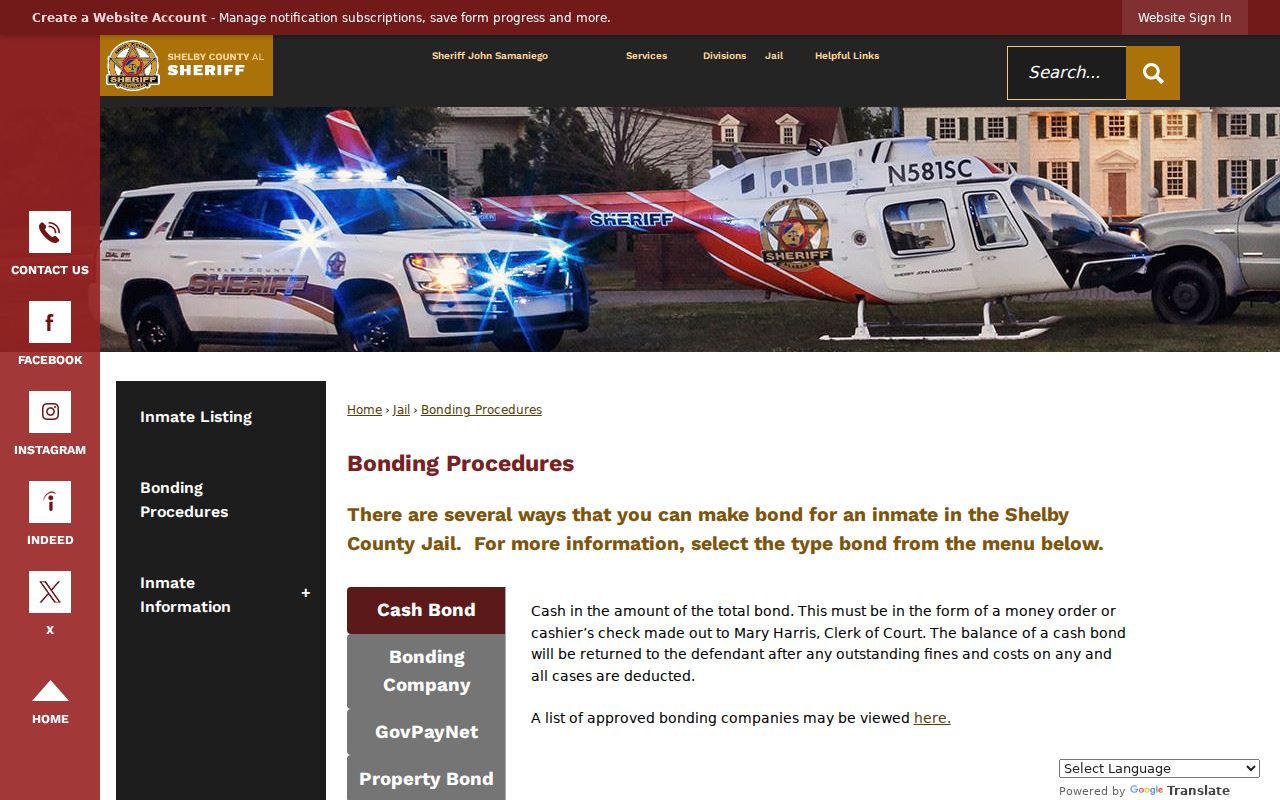
Bond status may appear beside a charge, but it does not tell whether that charge ended in conviction or dismissal.
Shelby County Charging Documents
The arrest itself does not settle the formal court accusation. A charging document states the alleged offense and starts or advances the court process. The form can vary with the case and procedure. Searchers may encounter a complaint, information, or indictment as a document label. The filed document, later amendments, and the disposition should be read together rather than treating the jail's first charge description as fixed.
| Complaint | Information | Indictment | |
|---|---|---|---|
| Basic meaning | A sworn accusation that alleges an offense | A formal accusation filed by a prosecutor | A formal accusation returned by a grand jury |
| What to verify | Named offense, defendant, and filing details | Filed counts and any later amendment | Each count returned and the Circuit Court case |
| What it does not prove | A final outcome | A conviction | Guilt or sentence |
The District Attorney's office can prosecute felony matters in the Eighteenth Judicial Circuit, while a city prosecutor or court may handle municipal charges. The location of the alleged offense matters. County magistrates cover felonies in Shelby County and specified county misdemeanors outside municipal limits, but a misdemeanor inside a municipality with a city court is generally handled there.
The Shelby County District Attorney contact page identifies the county prosecutor and official contact path.
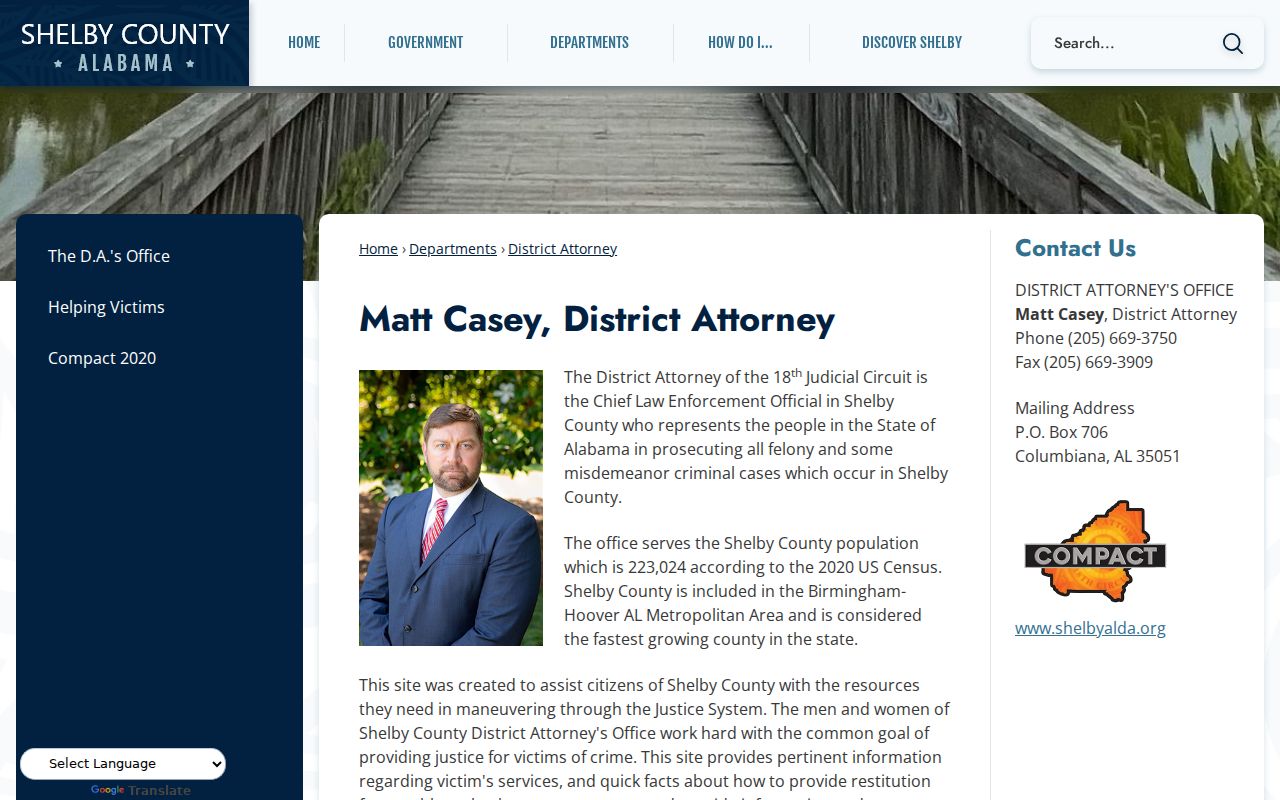
This county source helps route questions about prosecution while the Circuit Clerk remains the source for filed court records.
Shelby County Charge Status
A charge can change after the arrest. Prosecutor review, an indictment, court rulings, a plea, or dismissal may alter what appears in the file. Read the newest entry for each count, but keep the earlier entries in context. Pending means unresolved, not guilty. Amended or reduced means the filed accusation changed. Dismissed means that charge ended without a conviction. Nolle prosequi is a prosecutor's decision not to continue that charge at that time.
| Status | What It Means |
|---|---|
| Pending | The charge remains open and has no final disposition shown. |
| Amended or reduced | The wording, count, or severity changed; check the replacement charge. |
| Dropped or dismissed | The specific charge did not end in a conviction in that disposition. |
| Nolle prosequi | The prosecutor records that the charge will not be pursued at that point. |
A disposition is the most direct outcome field. If the public docket is thin or a certified result is needed, use the Circuit Clerk record request form. The request requires a $10 deposit; the clerk contacts the requester with the balance and sends copies after payment plus a self-addressed stamped envelope are received.
Shelby County Charge vs Conviction
A court charge records an accusation. A conviction records a guilty outcome by plea or finding. One Shelby County arrest may produce several booking charges, but the prosecutor may file different counts and each can reach a different result. The inmate list's charge description and bond line are therefore starting points, not a criminal-history conclusion.
| Charge | Conviction | |
|---|---|---|
| Stage | Accusation | Verdict or plea |
| Burden of Proof | Probable cause | Beyond reasonable doubt |
| Where confirmed | Charging document and current docket | Disposition, judgment, and sentence |
The Shelby County DA office page confirms the local prosecution office connected with state criminal cases.
The prosecutor's role in filing or pursuing charges is distinct from the judge's role in entering a conviction and sentence.
Shelby County Expunged Charge Records
Juvenile charges, sealed material, expunged records, minor names, Social Security numbers, and private financial identifiers can be restricted or redacted. An expungement is not an automatic edit to a jail or court page. Alabama uses a petition process for eligible misdemeanor, violation, traffic, municipal, and felony charges under specified statutory conditions.
- Restricted or sealed
- Access is limited by law or court authority. Ask the Shelby County record custodian whether release is allowed.
- Expunged
- Ordinary public criminal-history access changes only after the statutory petition, supporting records, and court action.
Shelby's checklist requires the CR-65 petition, one offense per petition, an ALEA or ACJIC Official Certified Criminal Record, and a certified arrest, disposition, or case action summary. The administrative filing fee is $500 per petition. It cannot be waived, though an indigent petitioner may receive a payment plan. The petition and documents must be paper-filed with the Circuit Clerk.
The ALEA criminal record expungement page explains the certified-history step that comes before filing.
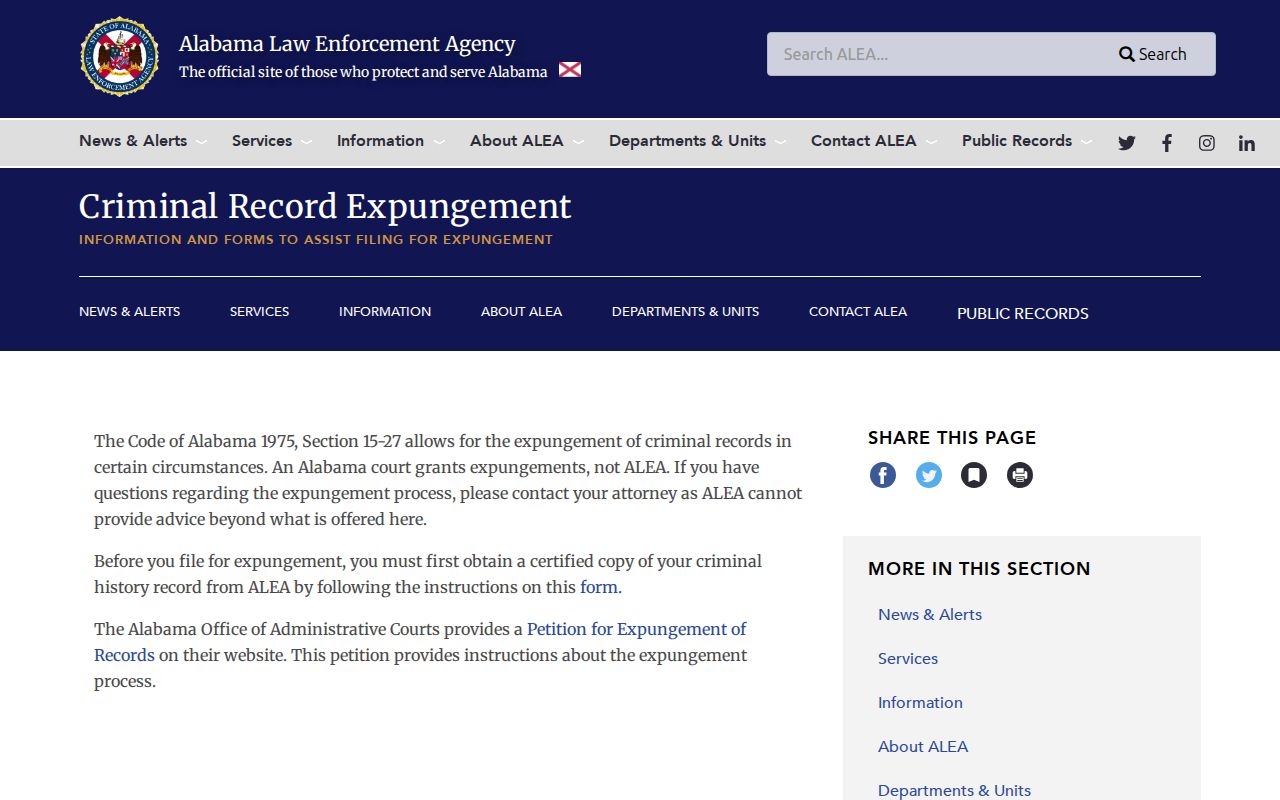
A granted petition can affect public access, but only the official court and agency records can confirm the result.
Shelby County Charge Levels
Shelby County Circuit Court handles felony cases, while District Court handles misdemeanors and preliminary criminal matters. A city court may hold ordinance and city misdemeanor charges. This routing is more useful than guessing from a short jail description. Each filed count should be tied to its court, case number, and disposition. One arrest can create several counts, and a later indictment can organize the felony accusations differently from the booking list.
The captured inmate listing does not show statute-code fields. Use the complaint, information, indictment, or certified case action record to confirm the legal code and filed charge level. Do not infer a statute from a shortened booking label.
Alias writs and bond labels add context but are not severity codes. The public jail list has shown SURE, NOBD, CASH, and COR as bond shorthand. The source capture does not establish those labels as statutory charge categories. Read the charge description separately from the bond type and amount, then confirm the filed offense in the court case.
Note: Municipal location matters because city misdemeanors may never appear in the Shelby County Circuit or District Court path.
Alabama Criminal History Channels
A local charge lookup and a statewide criminal history are not the same product. The ALEA Alabama background-check office is the official state contact for criminal-history record questions. ALEA also supplies the certified criminal history used in the expungement process. Shelby County's docket, clerk copies, jail listing, and municipal court records remain important because each reflects its own custodian and stage.
The state channel can answer criminal-history questions, but the Shelby County charge disposition still comes from the court that handled the case.
ADOC searches only people currently incarcerated in Alabama state prisons and says historical information is not online. It is not a broad arrest-record database. County jail custody belongs in the Sheriff's listing, and a person sentenced then transferred to state prison may move from one search system to the other.
The Alabama Department of Corrections contact page provides the statewide prison agency's records contact route.
This distinction keeps a county arrest, an open charge, and later state-prison custody from being treated as one record.
Shelby County Arrest Record Access
Alabama Code § 36-12-40 gives residents a baseline right to inspect and copy eligible public records unless an exception applies. Section 36-12-41 permits copies upon request and payment of lawful fees. For Shelby County court charges, use the Circuit Clerk. For Sheriff records, use the Sheriff's official channels or Shelby County's public-record request process. The county accepts requests online, by mail to Room 123 at 200 West College Street in Columbiana, or in person there and normally responds within 14 working days.
Access still depends on the custodian and any legal restriction. A public jail listing, court docket, county records response, and ALEA history can each show a different slice of the arrest-to-charge path.
Important: An arrest or charge lookup is not an FCRA consumer report and cannot support regulated employment, housing, credit, or insurance decisions.
Confirm Shelby County Court Charges
The strongest confirmation is a certified court disposition tied to the correct person and case number. The Circuit Clerk request form asks for the case number when known, or the approximate filing year, plus identifiers such as date of birth or aliases. Computerized record searches from 1993 forward have no search fee. Paper and archive or microfilm searches cost $20. Copy pages one through twenty cost $5, each added page costs $0.50, and each certification costs $5.
Prosecution questions can be routed to the Shelby County District Attorney at 112 North Main Street, Columbiana, AL 35051, (205) 669-3750. The Public Defender's Office, led by Michael Hensley, is at 205 N Main Street and can be reached at (205) 858-8402. Those offices serve different parties and do not replace the clerk as records custodian.
Finally, confirm venue. Shelby magistrates handle felonies occurring in the county and specified misdemeanors outside municipalities. Misdemeanors within a city that has its own court go through that court. This local split is why an incomplete county result may call for an Alabaster, Calera, Columbiana, Helena, Chelsea, or other municipal check instead of a third-party search.